
Jason Hiner
Jason Hiner is the Editor-in-Chief and Chief Content Officer of The Deep View. He's an award-winning journalist who has spent his career analyzing how tech has reshaped society. He covered AI for over a decade at ZDNET and CNET as it evolved from research labs to enterprise infrastructure to a daily reality for over a billion people. He came to The Deep View to cover AI every day and build a next-generation media company.
Articles
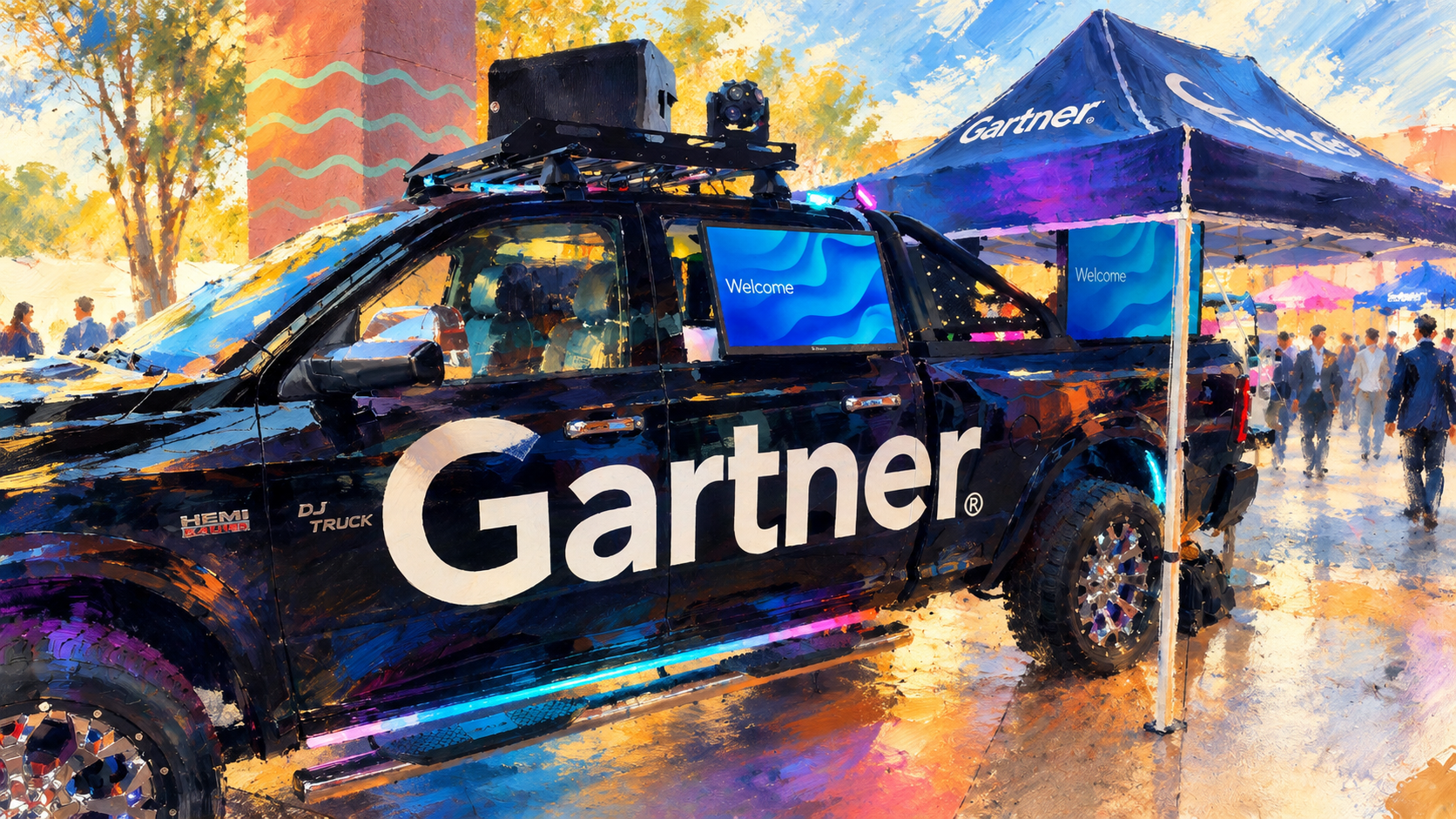
Gartner's 2027 AI predictions address the control gap
It will come as a surprise to no one that AI is outgrowing the systems designed to manage it.
At the Gartner IT Symposium/Xpo this week, the analyst firm offered both its top 10 strategic technology trends for 2027 and its top 10 strategic predictions for 2027 and both lists shared some common themes: AI is making software faster to create and work easier to automate, while making costs, security, and accountability more difficult to govern.
The two lists are distinct, but I've synthesized them into a set of insights to watch for 2027:
- AI's capabilities are outpacing its controls: While AI is letting employees hand off more work to machines, it's also forcing leaders to rethink how they control costs, grant access, and decide who's responsible when things go wrong.
- More autonomy needs better accountability: The systems for managing AI need to catch up with its growing autonomy. By 2028, 25% of enterprise security breaches will trace back to AI agents with mismanaged credentials, Gartner predicts. Honestly, that number seems conservative.
- Disposable software will change the enterprise: AI makes software far easier to create. Gartner predicts that by 2029, 80% of all new applications will be used for less than a year and made to be intentionally disposable. Still, disposable applications don't make the underlying data, integrations, or security disposable.
- Better context becomes a business advantage: Even the most powerful model still needs to understand how your organization works to be effective. Organizing your enterprise knowledge so AI can use it will become as consequential as choosing the right model. By 2027, companies that prioritize making their data AI-ready will increase agentic accuracy by up to 80% and reduce costs by up to 60%, gartner predicts.
- AI spending becomes a security issue: Gartner warned that lower price per token does not guarantee a better business outcome. Companies need to focus on the cost to finish useful work, including the retries and mistakes the models make along the way. In fact, Gartner warned that attackers could use this against companies, warning against "cost exhaustion" attacks that drive excessive AI consumption to run up your bill. Gartner predicts that 80% of companies with public-facing AI will experience such an attack by 2030.
Nevertheless, Gartner analyst Daryl Plummer in his presentation on the 2027 predictions at the event, warned, "Your worst action is when you focus strictly on cost reduction. Don't do that. Cost reduction is the denominator. Value is the numerator. You have to worry about both of them to make the equation go the direction that you want."
Plummer also dealt with the elephant in the room: the impact of AI on jobs. He told the crowd full of executives and directors, "Don't think 'replace workers.' Think 'augment and extend.' That's the better way to go."
Our Deeper View
The organizations that will benefit the most from AI will be the ones that can clearly explain what AI is doing and why, and exactly how the outcomes justify the costs. While that should sound obvious, there's been so much emphasis on AI adoption for the past few years that many enterprises have kicked the can down the road on ROI. Gartner believes that period is over, and organizations have to get more disciplined and more systematic about AI transparency, accountability, and governance. As I mentioned in our report on Gartner's surveys of executives on AI, only 11% of CFOs said they are seeing clear returns from AI and only 13% of CIOs say their organizations have seen transformational value from AI. These numbers are going to have to rise for stakeholders to continue to believe in AI and keep funding investment. For its part, Gartner's predictions offered actionable insights and mental models for enterprises to adopt to get this moving in a better direction.

Gartner exposes AI's growing value gap
Lots of companies are still racing to embrace as much AI as possible, but new data shows how much enterprises are struggling to show measurable business outcomes from AI.
This week at Gartner IT Symposium/Xpo, the company's annual flagship event, the analyst house revealed contrarian data on AI investment from surveys of CEOs and CIOs and other Gartner research:
- 81% of CIOs are increasing AI spend
- 44% of CEOs struggle to demonstrate AI-driven financial returns to stakeholders
- 13% of CIOs say their organizations have realized significant or transformational value from AI
- 11% of CFOs see clear returns from AI
- 4% of CIOs have plans in place to redesign roles for a human-agent workforce
- 58% of CIOs face increased pressure to deliver cost improvements from AI
These numbers highlight the fact that AI is rapidly shifting from experimental mode into a place where it has to show accountability for impact and ROI. Leaders are going to have to be able to articulate not just what AI can accomplish but how those benefits can justify the costs for both deployment and on-going operations.
"Volume is not value," said Alicia Mullery, Gartner analyst. "AI is creating a reckoning for organizations that lack fundamental disciplines, such as defining use-case value ahead of time and establishing criteria for when to walk away."
Gartner analyst David Furlonger further extrapolated, "The AI value problem will not be solved by simply adding more AI to existing ways of working."
In other words, if companies rely on AI to simply automate individual tasks then the economic upside is likely to remain limited and the pressure on executives will continue to increase. Instead, they're going to have to think bigger. Enterprises will need to do the harder work of redesigning workflows, reimagining decision-making processes, and rethinking organizational structures.
That's a lot to ask and it takes investment and organizational buy-in, but that's what will be required to drive the kind of transformations that match the rhetoric and the level of investment we're seeing around AI. It also requires bringing AI down from the clouds and thinking of it like all of the other technology shifts and changes from the past. Even if it's a more powerful and capable technology than what's come before, it still needs to earn its stripes in the same way and live by the same economic laws.
"AI is an enabler of outcomes, not an outcome itself," said Gartner analyst Joseph Provenza
Our Deeper View
The bottom line is that AI spending and adoption continue to accelerate but business outcomes tied to AI are coming under intense pressure to justify the enormous investments that have been made in recent years. The bigger opportunity has to come from enterprises changing how they operate rather than simply making existing operations more efficient. That nets out to the fact that winning with AI as an organization depends far less on deploying the latest models and AI tools than it does on organizational discipline, workforce redesign, and rethinking how the organization creates value. Again, that's the kind of hard work that the best organizations will have to master when it comes to implementing AI.
Databricks challenges AI's bigger-model strategy
What if the path to more capable AI in the real world wasn't building more powerful models?
Databricks launched new technology on Tuesday that offers today's existing models more extensive context and more persistent knowledge to improve AI performance. The company unveiled MemCurrent, a new memory layer for agents that can retain knowledge across sessions and create institutional memory for enterprises—and it offers some pretty impressive results.
Databricks reported these findings on the performance of MemCurrent:
- Agent success rate in carrying out real-world tasks tripled from 22% to 68%, based on an internal benchmark; and it did things 26% faster and with 31% fewer tokens
- Using three public benchmarks, MemCurrent performed as well as giving the agent every past conversation, but did it with 12x fewer tokens
- Databricks found that MemCurrent outperformed three open-source memory systems, OpenClaw, Mem0, and PropMem, on accuracy and efficiency
This is one of the hardest problems in the AI industry today. It's why startups like Pathway have built entirely new architectures to fix the endemic memory problems in LLMs. The issue leads to a number of challenges for agents, especially wasting time and money relearning the same behaviors over and over again. That creates a tradeoff to those using agents—you can make them smarter or you can make them faster and cheaper.
Databricks tackles the problem by giving agents two types of memory: episodic (the raw conversation history of what was learned) and derived (what can be discerned from the patterns, preferences, and workflows). Based on Databricks' own internal benchmark of 114 enterprise tasks, the average task with no memory was completed 22.3% of the time. With only episodic memory, it was completed 35.8% of the time. With only derived memory, it was completed 66.1% of the time. With both episodic and derived memory, it was completed 68.4% of the time.
"On your next project, you don’t have to explain the same thing again," Michael Bendersky, research director of AI at Databricks, told The Deep View. "The agent will … store your preferences and understand how you work on projects. We can propagate these preferences … from project to project implicitly without you doing anything."
Databricks customers can start using MemCurrent today, but keep in mind that it's an underlying architecture and not a product. It's now integrated into the company's AI data assistant, Genie, where it can immediately boost agents. Customers can also use the new Agent Bricks Memory, launching in beta, to add the MemCurrent capabilities to any of their own custom AI agents running any model or harness. It all happens within Databricks' Lakebase database.
Our Deeper View
Beyond the immediate value for Databricks' customers, MemCurrent is another sign that many of the most important breakthroughs in AI are coming from better systems surrounding the models and not just the advancements in the models themselves. Memory continues to emerge as one of the most problematic limitations of LLMs, the predominant architecture of today's AI. The memory problem leads to inconsistencies, slow answers, and above all, inefficiencies that waste a lot of tokens, compute, and money. It's like having an employee use their time to learn how to do something one day and then forget it at the end of the day and have to waste time learning the same thing over again the next day, and the next day—and so you keep hiring more and more employees to overcompensate. In this analogy, more and more employees are equivalent to the additional GPUs, compute, and data centers required to run agents. Right now, the industry's solution is to just build more and more data centers, but it's already very clear that's not a sustainable or desirable path forward. What we need instead is efficiency breakthroughs like this one from Databricks.

Why Inception's Mercury 3 upends the AI status quo
While the AI industry has bet heavily on LLMs and the massive data centers needed to scale them, one of the neolabs betting on a contrarian AI just released another new model that challenges the incumbent thesis.
On Monday, Inception announced Mercury 3, its latest flagship model that's a diffusion LLM that uses different technology than traditional LLMs, generates text much faster at a lower cost, and is now matching low- and mid-tier models from Anthropic and OpenAI on performance and quality. Inception also reported that it implemented swarms of Mercury 3 agents for recursive self improvement where they increased the overall speed of the model by 16% on top of the upgrades made by the Inception team itself.
"Mercury 3 is the most capable diffusion-based language model on the market," Inception CEO Stefano Ermon told The Deep View. "It's very intelligent. It's comparable to the Luna and Haiku models, but it's way faster. It's getting 1,000 tokens per second. It's almost instant in the way you get answers from these models."
Mercury 3 costs $0.10 per million input tokens and $0.35 per million output tokens. Compared to the leading models from Anthropic's Haiku 5.5 and OpenAI's GPT-6 Luna, that's the same price for input tokens and a 35% discount on output tokens. However, that's based on the launch price for Mercury 3, which is 50% off the eventual standard price. Inception hasn't said how long the launch promotion period will last. But Ermon told The Deep View that the company is working on developments that could allow it to make the launch price permanent in the weeks ahead.
However, thinking of Mercury 3 as a low-cost model isn't the right framing. Anthropic and OpenAI offer cut-rate prices on their budget models so that they can offer a low-cost option while charging steep premiums for their best models. Mercury 3 is Inception's flagship model and its number one benefit is speed more than cost. Inception claims that Mercury 3 performs 4x to 8x faster than Haiku 5.5, GPT-6 Luna, and GLM-5.3 Flash while performing better than all of them on agentic benchmarks.
The way Mercury 3 pulls this off is by parallelizing inference. Conventional LLMs generate text one token at a time in sequence. That's an autoregressive process, meaning that each token is based on the ones before it. Meanwhile, Mercury 3 can generate and refine multiple tokens at the same time. This takes advantage of the enormous parallel processing capabilities of GPUs in a much faster and more efficient way. That's what allows Inception's models to produce responses faster and at a lower cost. Diffusion models are used by many of the leading labs for image and video generation. It's the application of the technology to text that's the breakthrough here.
Mercury 3 is now using 40x as many parameters as Mercury 1 (released in February 2025), but the Inception team isn't saying how many total parameters are in the model. That likely means it's a smaller number and Inception doesn't want people to compare apples to oranges and underestimate the model. Still, Mercury 3 shows that diffusion LLMs are advancing rapidly and could match traditional frontier LLMs in the next year. That's likely why Google DeepMind is quietly working on the same technology as well, releasing DiffusionGemma in June. By the way, it uses 26 billion parameters (miniscule compared to the 1 trillion parameter frontier models) but also delivers similar breakthroughs in speed to Inception's Mercury models.
Our Deeper View
Mercury 3 calls into question the current approach of most of the leading AI labs, which have bet their architecture on building bigger LLMs and then count on faster hardware (and more of it) from Nvidia and other chipmakers to deliver improvements over time. If Inception is right about diffusion LLMs, then it would have big implications. The dilemma facing the AI industry is that improving model intelligence requires additional compute, and lots of it. Upgrading reasoning and increasing the number of agentic steps can typically increase costs and response time. So Inception's breakthrough on diffusion LLMs is all about faster AI response times and more efficient use of expensive GPU hardware, for now. The question remains whether it will be a niche use-case for more real-time AI applications or a bigger long-term challenger to the cutting edge frontier models.

6 timeless attributes for succeeding in the AI era
AI is making it easier for employees to work beyond their specialties and that has big implications for the future organizations of all sizes.
In this episode of The Deep View Conversations, we sit down with Bill Barton, chief operating officer at Rokt and the former leader of the Alexa team at Amazon. Rokt has gotten called out by some of the biggest tech companies in the world for its innovative use of AI inside the company. In fact, several of them have had Rokt come and talk to their teams about how they do it. So we wanted to have Bill on the show to share those insights with a larger audience.
Barton shares how Rokt is using an internal AI fleet across software development, finance, legal, security and other functions. He explains how AI is helping blur the boundaries between roles, why the company has moved from more than a dozen job ladders to four, and what it takes to turn experimentation into everyday practice.
Other topics covered:
• Why Bill returned to Rokt after trying retirement
• How AI is expanding the reach of generalists
• Enabling shared AI experimentation companywide
• Why fewer, more flexible systems can help teams move faster
• How Barton thinks about productivity gains and hiring
• What Google search reveals about frictionless AI
• Why more powerful tools can make it harder to step away from work
Bill also shares his six timeless attributes that can help anyone succeed in the AI era: relentlessness, resilience, rigorousness, inquisitiveness, optimism and humility.
For leaders rethinking their teams and professionals navigating changing roles, this conversation connects the possibilities of AI with the habits and judgment needed to make them useful.
📺 Watch on YouTube
🎧 Listen in your favorite podcast player
Subscribe to Deep View Conversations for interviews with the leaders shaping the future of AI, business, and technology: https://tdv.transistor.fm/
Nvidia's secret weapon for accelerating AI factories
Nvidia has figured out a way to build AI factories a lot faster.
These massive data centers bring together billions of dollars of computing equipment into a facility where a ton of different tech, power, cooling, and logistical systems have to work together seamlessly. Managing that kind of complexity is one of Nvidia's strengths.
With chip design, Nvidia architects everything virtually in a simulated environment long before the first manufacturing process starts. And since today's chips and processors have become enormously complex, that orchestration is where the magic happens, in terms of speed, efficiency, and innovation.
Nvidia is applying this same mindset to building AI factories by partnering with Siemens and implementing digital twins, or virtual replicas of real-world environments. This allows Nvidia and its partners, such as hyperscalers and neoscalers, to simulate these elaborate facilities ahead of time and rehearse all of the processes that make them work.
"You’re really building a data center scale computer, along with all the technology, it’s not just about the GPU," Vladimir Troy, Nvidia's VP of AI infrastructure, told The Deep View. "This is the fundamental part that I think people miss about accelerated computing. If you just optimize the GPU, then you have the fastest GPU, and your bottlenecks could be everywhere else."
Digital twins are the key to making it all happen by allowing engineers to simulate a facility's physical behavior. Siemens brings the simulation, automation, and industrial engineering expertise while Nvidia brings the accelerated computing, its Omniverse platform, and the experience with synthetic data.
"You can improve the time-to-token by [roughly] 40% if you’re using digital twins," Ales Alajbegovic, global program manager of industrial metaverse for Siemens, told The Deep View. "If you don’t use digital twins, I don’t even know how you can build this."
In this case, time-to-token is referring to the period from the time you break ground on the facility to the time it's serving its first useful AI query for the public. That metric is critical because AI usage continues to scale up, despite public sentiment turning negative on AI. In the past 18 months, we've gone from roughly 15% of the global population regularly using AI to 19%. And in places like Singapore and UAE, two-thirds of the population are already using it regularly.
All of that usage is putting tremendous strain on today's data centers. Without more data center capacity, the industry faces the risk of AI queries taking much longer to run, the most powerful models being limited to those who can afford to pay a premium, and slowing down some of the most promising uses of AI for science and healthcare. That's why so many of the world's leading cloud and data center companies are building out future capacity, despite limitations on power and component shortages for RAM and data storage.
"The demand is huge," said Alajbegovic. "Right now the whole industry … is running to build them."
Nvidia estimated that there are well over 100 projects underway globally.
Our Deeper View
Of course, the only thing less popular than AI among the general public right now might be data centers. However, as Nat Rubio-Licht has written, the backlash against data centers might also just be the public's easiest way to register its larger concerns about AI. It doesn't help that there are false narratives proliferating about AI using up community water supplies, for example. But the leaders of the AI industry also need to do a much better job of explaining how AI will benefit humanity, without resorting to unbelievable hyperboles about AI curing all diseases or leading to unlimited abundance and prosperity. People just aren't buying that. The work that Nvidia and Siemens are doing to build data centers faster is also making them enormously more efficient. However, with only so much power, water, and construction capacity, those efficiency gains are out of pure necessity. Still, it's also a great story about building responsibly and not wasting resources, while also making sure there's enough compute to power the AI of the future and keep it broadly accessible and affordable.

How open models change the economics of AI
Companies want to own the intelligence that makes their business valuable. So what will that mean for the AI models they use, and the systems they build around them?
In this episode of The Deep View Conversations, we sit down with Justin Boitano, VP of enterprise AI at Nvidia, to explore why NVIDIA is investing in open models and how enterprises are turning them into specialized intelligence.
Boitano talks about why NVIDIA makes Nemotron's datasets, training techniques and model weights openly available, how proprietary business knowledge can become a competitive advantage, and why lower token costs can unlock much greater demand for AI.
The conversation also examines why the agent harness that manages tools, memory and execution can matter as much as the model itself. Boitano shares how Nvidia worked with CrowdStrike on AI models for cybersecurity, why AI incidents need the equivalent of an aviation flight recorder, and how OpenShell moves agent controls into the infrastructure layer.
Other topics covered:
• Why NVIDIA is building open models alongside its chip business
• What Nemotron needs to compete with China's open models
• Owning institutional knowledge, protecting data and controlling AI costs
• How model development helps NVIDIA improve hardware efficiency
• Why harness engineering is becoming a new frontier for AI
• Moving cybersecurity from finding bugs to verifying and fixing them
• Transparency and learning from AI incidents
• OpenShell, sandboxing and enforceable limits on agent access
• How Justin uses Hermes as an AI chief of staff
• Jensen Huang's approach to priorities and team alignment
If you're deciding how to build enterprise AI, where your company's competitive advantage comes from, or how to give agents useful access without giving them unlimited control, this conversation offers a perspective from Nvidia's work across the ecosystem.
📺 Watch on YouTube
🎧 Listen in your favorite podcast player
Subscribe to Deep View Conversations for interviews with the leaders shaping the future of AI, business, and technology: https://tdv.transistor.fm/

Why Anthropic's open hardware move exploded in interest
Anthropic is the only one of three major frontier AI labs in the US that doesn't offer an open model. But a recent Anthropic move shows that the company does still want to support open ecosystems.
In a move that has largely flown under the radar, Anthropic announced its Model Hardware Standard (MHS) at the end of August as "the MCP for hardware," as Alek Kemeny, a member of technical staff on Anthropic's Beneficial Deployments team, told The Deep View.
MCP (Model Context Protocol) is an open standard that enables AI models and agents to connect to external tools, data, and services through a common interface that Anthropic developed and open-sourced in November 2024. It has since become an industry standard with around 500 million monthly SDK downloads, and has only become more relevant in recent months with the rise of AI agents that are hungry for context and data.
MHS hopes to do for hardware and devices what MCP has done for software and services. It wants to give AI models and agents a common interface for interacting with thousands of otherwise incompatible systems. While MHS was conceived as a way for scientists to drive lab automation using Claude, the response to the announcement has been intense, the Anthropic team said, and has spread far beyond science labs. Kemeny noted that in the first two weeks after the announcement, Anthropic received 30x the number of organizations requesting to participate than Anthropic had originally planned for.
And the types of organizations that applied spanned a lot of different industries from semiconductors, advanced manufacturing, automotive, food processing, aerospace, energy, and critical infrastructure.
Some of the benefits already being reported include:
- Stabilizing quantum computers: QuEra used MHS to help Claude develop a program for controlling lasers used in its quantum computers. The finished program restored the laser correctly in 695 of 700 tests. Difficult recoveries took 10 to 14 seconds, compared with 5 to 10 minutes for a human expert.
- Running lab experiments automatically: Carnegie Mellon researchers used MHS to connect a liquid handler, plate reader, robotic arm, and cameras. An AI agent ran an experiment, decided the first result was not good enough, changed the concentration range and tried again on its own. The test used colored dye as a stand-in for a drug candidate. CMU says testing real drug candidates is the next step.
- Giving labs a 24/7 operator: A University of Washington PhD student connected six lab instruments through MHS in less than a week. He built a system where AI can watch a DNA amplification experiment and stop it at the right time. He also connected a robotic arm and liquid handler so they could move lab plates safely between machines.
"Beneficial Deployments is really charged with seeing, owning, and championing our public benefit mission, and ensuring that the benefits of AI extend to positive outcomes for humanity," Jonah Cool, head of our partnerships and deployment at Anthropic, told The Deep View during the same interview with Kemeny. "As it pertains to science, a lot of our work is really inspired by the guiding light of the essay that our CEO Dario [Amodei] wrote, Machines of Loving Grace."
Our Deeper View
Anthropic has gained a reputation for being anti-open-source, mostly due to the fact that Amodei has raised safety concerns about open-weights models. However, the successful open-source rollout of MCP provides a counterweight, as does Anthropic's commitment to and support for the scientific community, which tends to lean on open ecosystems for the purposes of both sharing research and verifying results. Anthropic still describes MHS as being an application-only research preview. But they asserted that they intend to open-source MHS in the hope of it becoming an industry standard like MCP. Kemeny and Cool explained that they're first working with industry partners to test safety and security while the models are now operating on real-world equipment. It's also a fun note that since Cool has a PhD in cell biology, one of the leaders of this initiative is essentially named Dr. Cool. That kind of marketing is nearly as good as making it an open platform.

Can guardian agents make enterprise AI safer?
AI agents can act faster than humans can review them. So how do companies keep control without slowing everything down?
In this episode of The Deep View Conversations, Jason Hiner sits down with Blake Brannon, chief innovation officer and a co-founder of OneTrust, to explore why AI governance needs to evolve from static rules to decisions made in real time.
Brannon explains why an agent can inherit an employee's identity and access without inheriting their trust. He makes the case for independent guardian agents that evaluate what other agents are trying to do, apply a company's policies, and redirect or block actions when necessary.
One example captures the challenge: deleting CRM records could be routine cleanup or an attempt to inflate a salesperson's performance. The action alone doesn't tell you whether it should be allowed. Its purpose matters.
Topics covered:
• How OneTrust evolved from data privacy to AI governance
• Why first-party data and customer trust go together
• Why human review can't keep pace with a growing population of agents
• How guardian agents and independent checks could help close the trust gap
• The difference between containing AI and aligning it with business policies
• Why governance should help companies move faster
• What the bring-your-own-device era teaches us about AI adoption
• How Blake uses visual storytelling and voice-to-text tools to work more effectively
If you're deploying AI agents and trying to move beyond experiments without giving up control, this conversation offers a practical way to think about the systems that need to surround them.
📺 Watch on YouTube
🎧 Listen in your favorite podcast player
Subscribe to Deep View Conversations for interviews with the leaders shaping the future of AI, business, and technology: tdv.transitor.fm
or get it straight to your inbox, for free!
Get our free, daily newsletter that makes you smarter about AI. Read by 750,000+ from Google, Meta, Microsoft, a16z and more.